


The Malachite Palace
BOOK DESCRIPTION
This original fairy tale celebrates the importance of freedom and the need to take responsibility for one’s own freedom. Although the queen, the governess, and the lady-in-waiting all believe that the young princess is too delicate and refined to play with the neighborhood children, the princess herself decides otherwise…
CD DESCRIPTION
This CD contains the reading of three of my favorite stories: Jordi’s Star, The Malachite Palace, and The Unicorn of the West. It was a very meaningful experience for me to record these books, to choose the music to accompany the reading, and to share after each recording the story of the creation of each book. The CD became even more meaningful as it was played during the performance of The Malachite Palace as a ballet.
AUTHOR’S NOTE
The word “malachite” fascinated me since childhood. In the beautiful poem “A Margarita” the great Nicaraguan poet Rubén Darío describes a king who had “un palacio de diamantes, un kiosco de malaquita y un rebaño de elefantes” [a palace made of diamonds, a malaquite kiosk and an elephant herd]. The whole world he painted delighted me, but it was the “malachite kiosk” that intrigued me. Not knowing what malachite was, the sound of the word was in itself fascinating. Many years later I had the opportunity to visit the extraordinary museum of The Hermitage in St. Petersburg, and there, to my surprise, was a magnificent malachite kiosk. Did Darío heard about this outrageous gift to a tzar? Or was the imagination of the poet the inspiration for the kiosk? I probably will never know, but haunted by the beauty of word and stone, one day I simply began writing: “There once was a princess who lived in a malachite palace…” As the story evolved, the values I hold true: the value of freedom and the responsibilities it demands, the richness of diversity, enriched the story. And what a pleasure to have an extraordinary artist as Leonid Gore create such delicate and inspiring illustrations that make the book itself a gem!
An additional source of joy has been to see The Malachite Palace turned in 2008 into a magnificent ballet by the Ballet Bras d’Or in Cape Breton, NS, Canada.
REVIEWS
Publishers Weekly
Gore’s (The Pomegranate Seeds) acrylic and ink illustrations, spun like gossamer and lit with an inner radiance, lend their magic to a tale about a lonely princess. Confined to the castle and forbidden to play with the children outside the gates (whom the queen, the governess and the lady-in-waiting deem common), the princess is delighted when a little yellow bird flies in through the window, filling the palace with “a light and joyful music.” After it is captured and placed in a cage, however, the little bird ceases to sing. Only when she sets it free, turning its cage into a bird feeder so that it and its friends may come and go at will, does it sing joyfully again. Seeing the bird’s happiness inspires the princess to seek her own, and she ventures for the first time beyond the palace gates to play with the other children. Ada (Mediopollito) puts a bit of a fresh spin on the tired metaphor of the bird in the gilded cage by having the girl take responsibility for her own freedom. But it is Gore’s airy, diaphanous illustrations that lift the tale above the sum of its parts. Studies in the refinements of light and texture, they appear overlaid with a delicate, filmy gauze, and their weightless elegance imbues the translucent green walls of the malachite palace and the sun-dappled interiors with a mysterious, ethereal beauty. Ages 4-8.
School Library Journal
Pre-School–Grade 3: A lovely picture book in the grand tradition of European fairy tales. Locked away in her malachite castle, a lonely little princess yearns for the one thing she does not have a friend. Then one day, a tiny yellow bird with a beautiful song visits the palace, and the princess’s lady-in-waiting and governess lock it in a silver cage. Trapped, the bird stops singing, until the princess removes the cage door. The bird flies away singing a joyful song and soon returns, accompanied by many friends, to the open cage the child has filled with food and placed on the balcony. Following the bird’s example, the princess ventures outside the palace doors, where she joins the children laughing and playing. Although the story is not highly original, youngsters will enjoy its gently familiarity. The artwork, lovingly crafted by a leading Russian children’s book illustrator, is striking. Softly muted acrylic and ink drawings depict a dreamlike land while expressing the princess’s isolation. A predictable, yet comforting, read. –Denise E. Agosto, formerly at Midland County Public Library, TX.
Booklist
Ages 4-8: An original fairy tale/fable, translated from Spanish, tells a touching story of a privileged child in a gilded cage, who sets herself free. The princess lives in splendor in the malachite palace, but she is shut in there. She hears the laughter of children playing in the fields outside the gates, but she is forbidden to join the “common, ignorant” crowd. Gore’s full-page, acrylic-and-ink pictures, in rich, shimmering shades of green and red, show the angelic child nearly overwhelmed by her flamboyant care-givers: the arrogant queen, the repressive governess, the protective lady-in-waiting. Then a singing bird flies into the child’s room; the ladies lock him into a silver cage, and he stops singing–until the princess opens the cage and lets him fly away. She transforms the empty cage into an open archway, and finally she opens the ornate palace gates for herself and runs outside to play with the children. The theatrical illustrations provide a lavish setting for the sturdy child’s struggle to leave home. –Hazel Rochman.
Kirkus Reviews
From Ada (The Lizard and the Sun, 1997, etc.), an original fairy tale that is predictable, elevated to beauty by Gore’s paintings. A princess child is isolated in a palace, away from the “rude,” “ignorant,” and “common” children who play outside her gates. One day an exquisite yellow bird visits her, singing a joyful tune; the princess cages it and its joy fades. She frees the bird, and eventually frees herself, joining the children outside. The message is heavy-handed, the telling is without style, the setting is nondescript. The illustrations, however, are ephemeral: The princess and her surroundings are depicted in Gore’s paintings as if they are seen through gauze. The angles of the characters’ faces, the sharp definition of the cage, the detailed scrollwork of the windows and gates are all in perfect contrast to the hazy existence of a friendless princess an isolation based on prejudice and hearsay, and one to be willingly shattered. (Picture book. 4-8) — Copyright ©1998, Kirkus Associates, LP.
This is a wonderful picture book, both the writing and the illustrations. It’s about the cruelty and foolishness of snobbery. A very sweet little princess is kept inside the palace gates because the queen, the governess and the lady-in-waiting think she is too good to be mixing in with the riff-raff rabble kids outside the gates. She’s not happy. One day the queen and her cronies trap a bird that has flown in to the palace but it isn’t happy and starts to deteriorate, so the little princess helps it escape. In the process the princess makes a very important change in the way she is treated. The illustrations of this little princess are just perfect and they capture her emotions in such detail. The illustrations glow with a soft light and the deep green walls of the malachite palace add magic to the pictures and also a sort of innocence. This is a book that shows the strength that a child can have when they decide to live up to their true nature and think for themselves. It should help kids see that they can come up with ideas on their own for doing the right thing and that sometimes grown-ups can make mistakes. I love this book. (–Terrie Reese, Little Chute, WI, US, Amazon Top 500 Reviewer).
“The Malachite Palace” is a beautiful book about friendship and respect. The little princess is not allowed to play with the common children outside because they are “rude” and “ignorant”, according to her lady-in-waiting, governess, and the queen. One day she finds a little yellow bird, and decides to keep it for a friend. But being in the cage makes the little bird weak and sad, and the princess must find a way to set the bird free, and in doing so, show the women that watch over her that she cannot grow or be happy unless she is allowed to have friends. The illustrations in this book are exquisite, almost ethereal. It is a treasure for any children’s library, and sure to be a favorite. (–N. Bernadsky, Conway, AR, US, Amazon).
“A caged bird will not sing, and a child locked away in a protective castle will not flourish. Ada’s fairytale speaks to the heart and soul of childhood, to the power of truth and freedom. Set off by Gore’s magnificent paintings, this is a near-perfect melding of classic story and artwork.” (Family Life, June/July, 1998)
“[…] This is a fairy tale with a strong young girl who need no magic to make her world better.” (–Natalie Soto.On the Shelf – Rocky Mountain News. August, 1998)
Activities
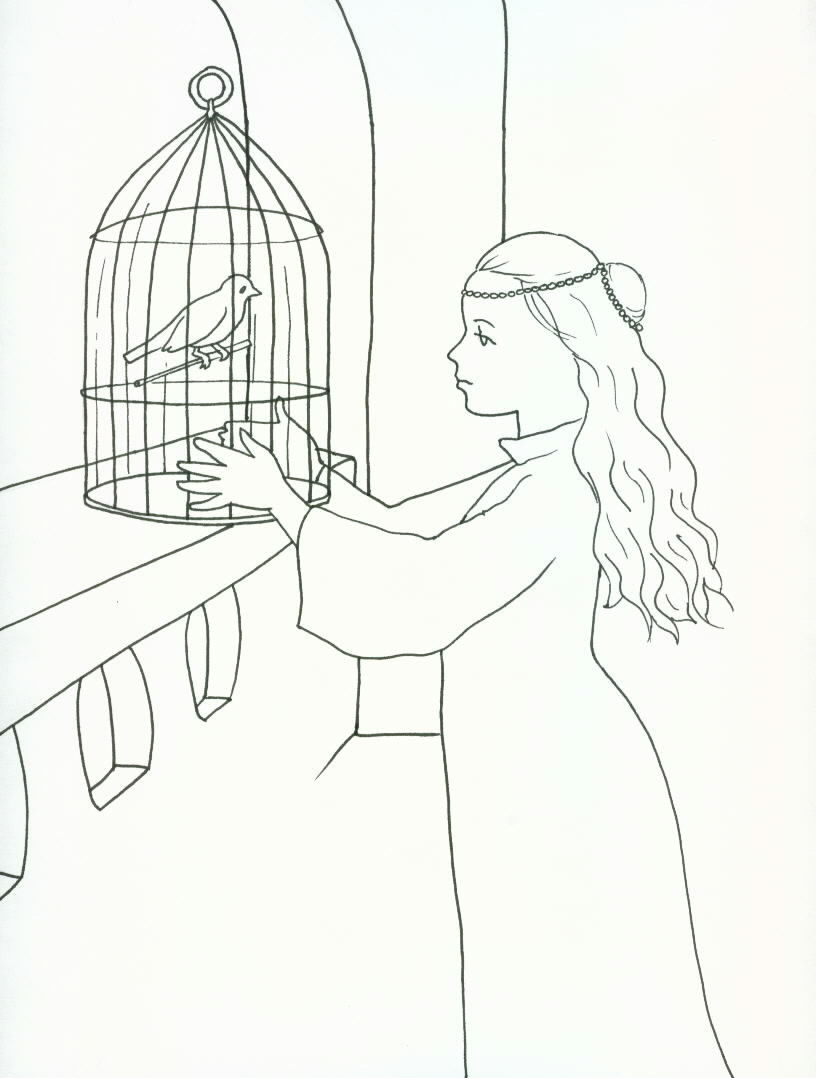
Print The Malachite Palace Coloring Page
READERS’ RESPONSES
If you have enjoyed reading or sharing this book, I would very much like to hear from you. Please click here to send your comments.
