
The Three Golden Oranges
BOOK DESCRIPTION
Far on the other side of the mountains, next to an enchanted castle, grows a tree with three golden oranges. It is there that the three brothers–Santiago, Tomás, and Matías–must journey if they wish to find a wife. Once they reach their destination, the brothers must carefully pick the oranges and bring them back to the old woman who lives in a cave on the cliffs overlooking the sea. But, “In order to find your wives, you will need to work together,” the old woman has said. “Woe to you if you do not follow my advice!”
Each of the brothers wants something different. Santiago wants a wife who is beautiful. Tomás wants one who is both rich and beautiful. But Matías, the youngest brother, longs for a woman who is kind, joyful, and loving…someone he could love very much in return. Will the brothers be able to avert misfortune by working together? Will they be strong enough to break the spell that a wicked sorcerer has placed on the castle?
Master storyteller Alma Flor Ada offers a poetic and magical retelling of a well-loved traditional story about Blancaflor, a mythical young woman who appears in various stories throughout the Hispanic world. This traditional Spanish folktale celebrates a spirit of cooperation and brotherly love. Reg Cartwright’s boldly colorful and exquisitely stylized art is a perfect accompaniment.
AUTHOR’S NOTE
The Spanish folklore is abundant in wonderful tales, as diverse as the country from which they originate. Many of them were brought to Spain by the Arabs, who inhabited large areas of the Iberian Peninsula from 711 to 1492. The magic characteristic of the stories of One and a Thousand Nights, is somewhat present in this tale of enchantment.
Retelling this story was an exciting experience which I was happy to replicate in the retelling of the tales included in Tales Our Abuelitas Told, compiled in collaboration with Isabel Campoy who has retold many of the traditional folktales of Spanish-speaking countries contained in that book, also published by Atheneum.
BOOK REVIEWS
Publishers Weekly
Ada adds feminist panache to her retelling of the classic Spanish folktale. Matías and his two older brothers wish to wed, but there is not a single unmarried girl in all their lush valley. The old woman who lives on the cliff by the sea has the answer: if they travel to a distant castle, pick three golden oranges and bring them to her, each brother will have the wife he desires. But they must work together or, she cautions, “Woe to you if you do not follow my advice.” Matías, the only one to comply, wins his destined bride, the kind Blancaflor, and she helps him to save both his brothers and her bewitched sisters. Ada’s author’s note cites no specific source for her retelling, but does contrast her Blancaflor tale with some of the more popular versions. As in her original fairy tale, The Malachite Palace, she adopts a straightforward, sometimes bland narrative voice (“When Matías… saw that there was only one orange left, he felt very sad for his brothers”). But the artwork will sustain readers’ interest. Cartwright’s (The Band Over the Hill) vivid and varied vignettes and spot illustrations rendered in flat, round shapes and bold colors evoke folk art while displaying a sense of life and movement. The pictures here are as succulent as the oranges themselves. Ages 5-8. (May) © 1999 Reed Business Information, Inc.
School Library Journal
Grade 1-5: In this well-known Spanish folktale, three brothers are instructed by their mother to find wives. An old woman advises them that they must work together and tells them to travel to a castle grove, pick three golden oranges, and together bring them back to her. The two older brothers, who are vain and shallow, disregard her advice and are put into the castle’s prison, where they are rescued by Matías, the compassionate youngest son who follows the woman’s directions and gets the fruit. On the way home, the older brothers open their oranges and once again find themselves in the dungeon. When Matías brings his fruit back to the old woman, she cuts it open and a dove flies out. Later, he removes a thorn from the bird’s neck and it turns into a young woman named Blancaflor. They return to the castle and free her family from a spell. Matías marries Blancaflor, but her sisters refuse to marry his brothers. Cartwright’s flat, folk-art style characters wear traditional Spanish costumes. The yellows, greens, and oranges in the rounded patchwork countryside contrast with the black of the brothers’ clothing and bright blue skies. Full-page illustrations alternate with smaller pictures to move the eye and relieve the long text. Ada keeps the story as simple as its many twists and turns allow, but this is still a complicated tale. An author’s note discusses variations of the folktale and how oranges fit into Spain’s history. –Sally Bates Goodroe, Harris County Public Library, Houston, TX © 1999 Reed Business Information, Inc.
Booklist
In this version of a popular Hispanic folktale, three brothers in search of brides are told by an old woman that they will each find the wives they want–if they work together. She sends them on a quest to bring her three golden oranges. Of course, the two oldest try on their own and fail, and the youngest pulls them together. In a nice twist, he is finally rewarded by a strong bride who chooses him. The text is long, sometimes too long, especially with the repetition of the pattern of three; but the telling is lively, the message is light, and the stylized oil paintings in bright colors combine magic and personality, rhythm and character, with a strong sense of drama. –Hazel Rochman
Latin Baby
LBBC’s recommendation for the August Libro del Mes, is Alma Flor Ada’s The Three Golden Oranges. Ada’s adaptation of the classic Spanish fairytale is spectacular with changes to the original story line that create a tale that flows simply and beautifully… Unlike most fairytale endings in which the handsome prince is rescuing the princess with his extraordinary strength, agility and dashing good looks, Three Golden Oranges emphasizes the value of honesty, selflessness, honor, and dedication. When asked what type of wife he wants, Matías asks for one who is “kind, joyful and someone I could love very much” as opposed to his brothers who desire wealth and beauty. And in a novel turn of events, it is the sweet Blancaflor who chooses Matías to be her husband, rather than the other way around! Yay! Altogether what a great message…and one that I hope to impart to my own son and daughter… More »
Kirkus Reviews
Ada (Under the Royal Palms, 1998, etc.) reworks the traditional story of Blancaflor, taking swipes at greed, vanity, and the practice of arranged marriages in the process. Some well-traveled types help make the points: older brothers full of themselves and not above treachery; the innocent, well-intentioned youngest brother; a wise older woman; and a young woman in dire circumstances, with the moral fiber to endure. Here the story revolves around three brothers wishing to wed, and how they seek the advice of an elderly woman and then ignore all her warnings. The two bad-of-heart brothers wind up in a castle jail, and then marriageless; Matías, the pure one, liberates a family under a sorcerer’s spell, gains love and marriage, and fulfills his mother’s wishes. Ada invests her lengthy retelling with a quiet musicality that softens the predictability of the narrative. Meanwhile, the Spanish countryside comes blazingly alive under the bold illustrations of Cartwright’s stylized, utterly transporting artwork. (Picture book/folklore. 5-8) — © 1999, Kirkus Associates, LP. All rights reserved.
Activities
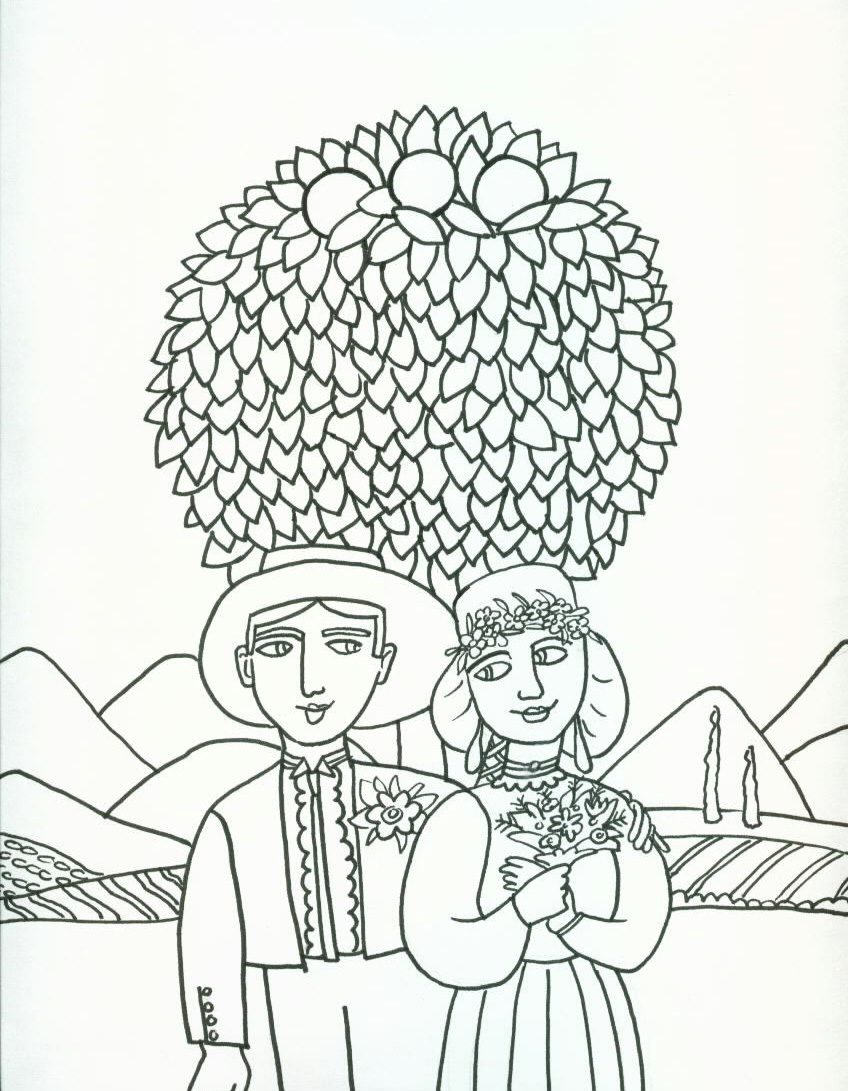
Print The Three Golden Oranges Coloring Page
READERS’ RESPONSES
If you have enjoyed reading or sharing this book, I would very much like to hear from you. Please click here to send your comments.
